
A warning on the dash. A new noise. A patch of oil on the driveway. They all raise the same question. Does this need a booking today, or will it keep until the next service?
Here is the short answer. The common Mercedes problems that bring cars in sort into three bands. Anything touching the brakes gets booked now. A diesel emissions message, a gear change gone harsh, or oil you can see dripping gets booked this month. A slow oil weep, or a car that settles a little overnight, can wait for the next service.
Why is my Mercedes showing a brake pad or parking brake warning?
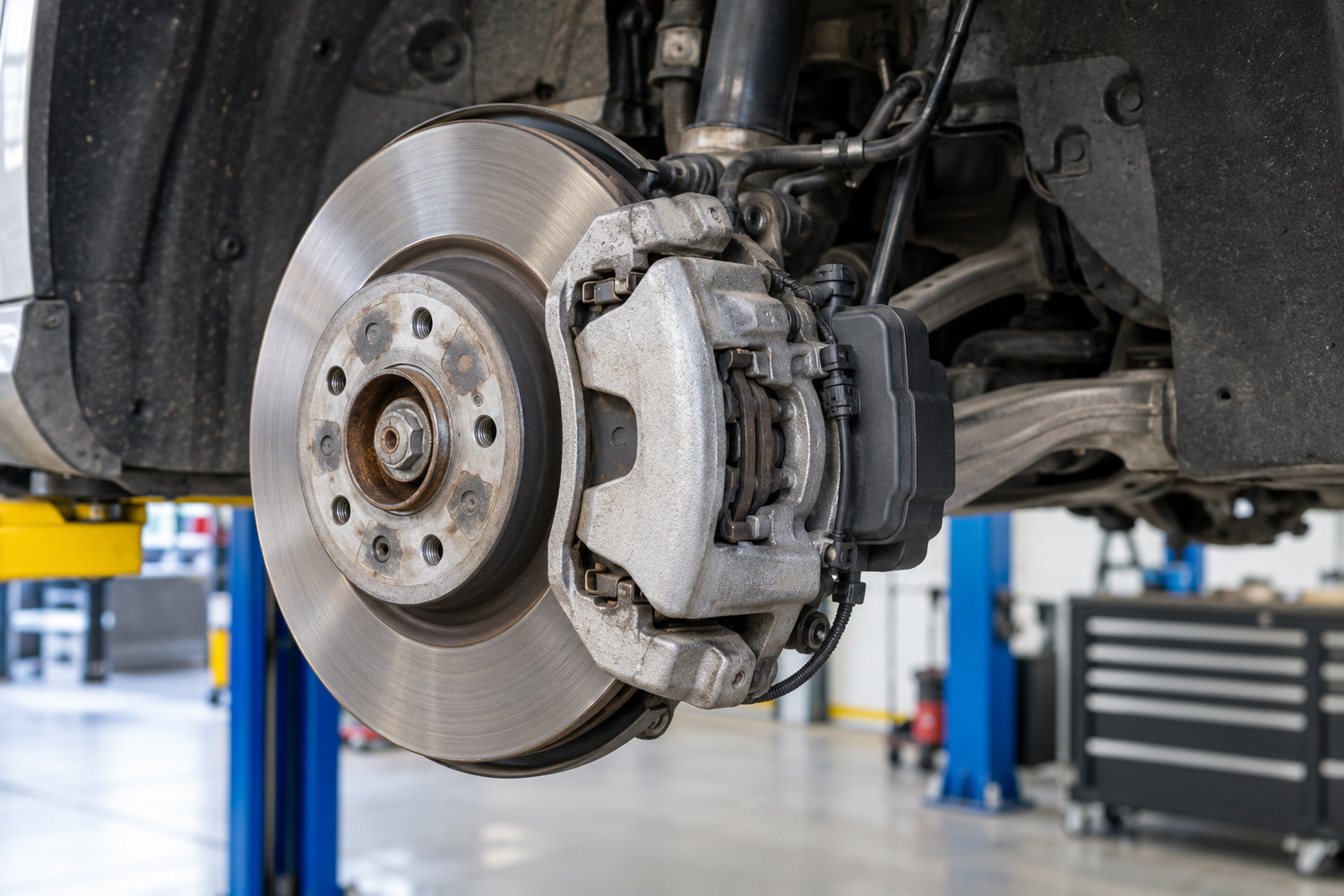
Two different brake warnings turn up on a Mercedes, and they are easy to mix up.
The brake wear sensor is the simpler one. A thin wire sits inside the pad material. As the pad thins, the disc grinds through the wire. The broken circuit lights the dash: a pad has reached its wear limit.
The electronic parking brake is the other one. A switch on the console takes the place of the handbrake lever. Bendix, which supplies brake parts in Australia, describes more than one design. One uses a stepper motor on the back of the caliper, acting on the piston. Another keeps a cable and pulls it with a motor instead of a lever.
What you notice is a park brake fault message, a rear wheel that drags, or a brake that will not let go. On the fully electric design, a flat battery can leave the brake stuck on. Freeing it then needs a scan tool, not a jump start. A car parked on a Chatswood side street with the brake locked on cannot be pushed clear, so that one is a tow.
On that same design, the rear pads cannot come out until the caliper motors are wound back electronically. TRW, which makes electric park brake calipers, says a diagnostic tool must be used for that. The calipers are released and set to pad change mode before the car goes on the hoist. So a rear pad warning on a Mercedes with one of these brakes needs a workshop with a scan tool. One more reason not to sit on it: a NSW pink slip treats a live brake or handbrake fault as a fail.
The verdict: book it now. Brakes are the one group here where waiting buys you nothing.
Why is my Mercedes leaking oil?
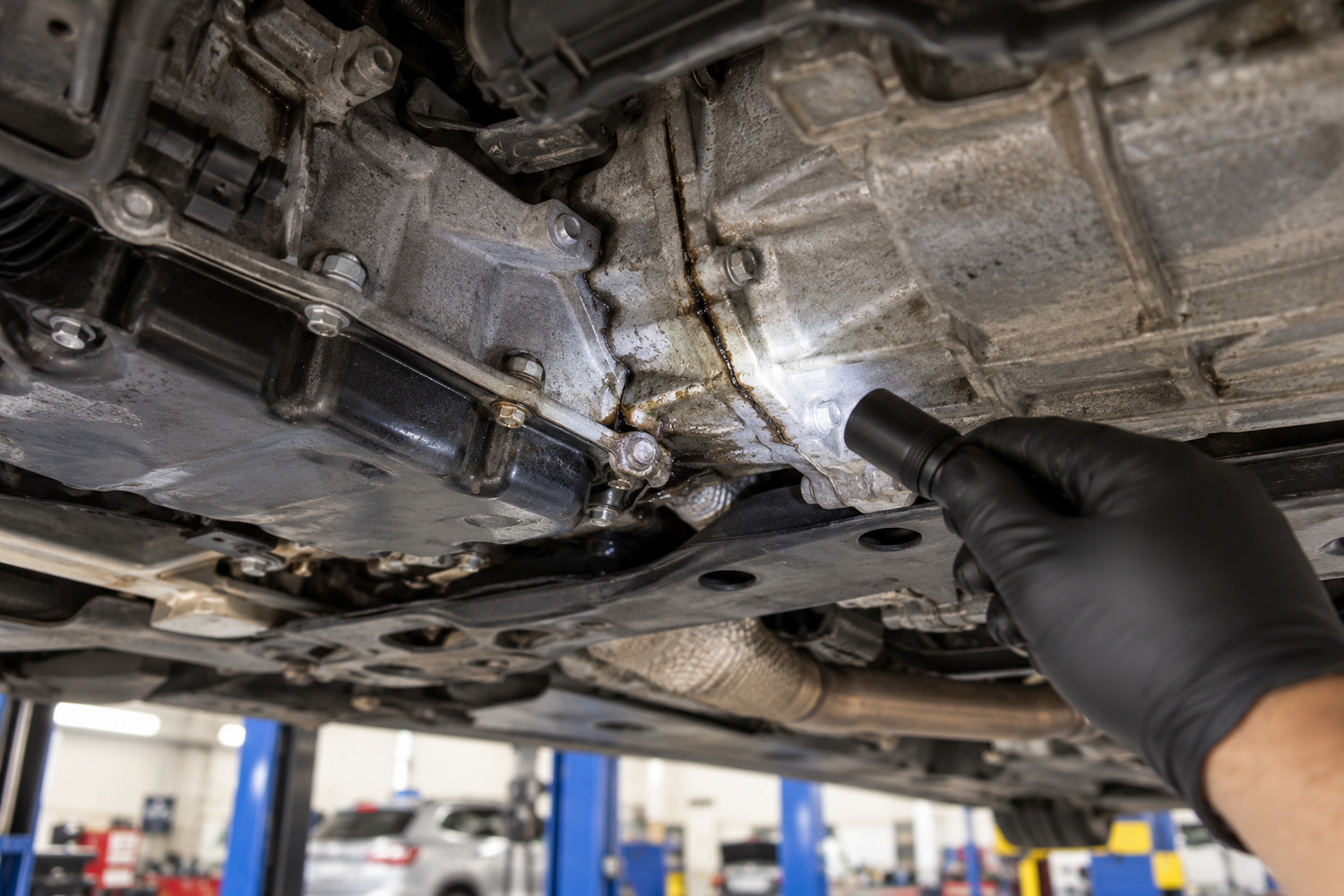
An oil leak on an older Mercedes is usually a hardened seal rather than a broken part.
Three places are worth knowing. The valve cover gasket seals the valve cover to the top of the cylinder head. The rubber goes hard with heat and age until it stops sealing. The crankcase breather system carries engine gases through rubber hoses that go brittle. The joint where the breather cover meets the valve cover is sealed with sealant rather than a gasket, so it weeps as that sealant ages. The oil cooler is sealed at its connections with O-rings, which leak once they harden. So does the joint between the oil filter housing and the cooler.
That last one matters before you read a quote. The seals cost very little. Reaching them does not, because a good deal has to come off the engine first. It is why two leaks that look the same on the floor can be priced quite differently.
On the 3.0 litre V6 diesel there is a trap. The oil cooler sits in the valley between the two banks of cylinders, high up and well forward. Oil from a failed seal there runs back and down the rear of the engine, then shows up near the gearbox. So it reads as a rear main seal leak. That seal sits where the engine meets the gearbox, and it is a far bigger job.
From the driver’s seat the first sign is usually a smell of hot oil after a drive. Oil runs back and down, so the wet patch is never where the leak began. Follow the trail to the furthest forward and highest point you can see.
The verdict: it depends on the rate. A film and a smell, with the oil level holding: mention it at the next service. A drip that marks the floor overnight: book it this month.
What does an AdBlue warning on a Mercedes diesel mean?

AdBlue is a clear fluid, mostly water with urea in it. It sits in its own small tank and is sprayed into the exhaust. Its job is to cut nitrogen oxides, one of the gases diesel engines are regulated on. The part doing the work is the SCR catalyst, and SCR stands for selective catalytic reduction.
The warning is not a reminder. It opens a countdown, and the shape of that countdown is set by rule. Australia’s design rule for light vehicle emissions requires a warning at least 2,400 kilometres of driving before the tank runs dry. The warning then grows more insistent, and cannot be switched off until the fluid is topped up. The car also has to be built so it cannot be driven with an empty tank. One permitted design counts down the starts left, then stops the engine restarting.
Here is the part that catches owners out. A fault triggers the same countdown, not just a low tank. Fluid that is not to specification brings up its own message, and so does a dosing system that is not injecting properly. The rule gives ‘incorrect AdBlue detected’ and ‘AdBlue dosing malfunction’ as examples of that wording. If it is not put right, the same countdown follows. Topping the tank up will not clear a fault with the pump, the heater, the level sensor, or the injector.
The diesel particulate filter, or DPF, is the soot trap further along the same exhaust. It is a separate part, and nothing you pour in tops it up. A filter message is not an AdBlue job.
The verdict: book it this month. The warning is built to give you distance to work with. The countdown ends in a car that will not start.
Which common Mercedes problems can wait, and which cannot?

Here is the same judgement in one view. The right-hand column is how long you have before booking, not how long the job takes.
If you own a Mercedes that is out of warranty, you are weighing up what is worth spending on. Booking something that would have kept wastes money. Leaving something that would not have kept costs more than the repair.
| What you notice | What it usually is | How long it can wait |
|---|---|---|
| Brake pad warning, park brake fault message, or a brake that will not release | A worn rear pad, or the motor or wiring at the rear caliper | Book it now |
| Smell of hot oil, a film underneath, or a drip on the floor | A hardened valve cover gasket, breather joint, or oil cooler seal | A film: mention it at the next service. A drip: book it this month |
| AdBlue or exhaust emissions message on a diesel | Low fluid, or a fault in the dosing system | Book it this month |
| Settles on one corner overnight, or sits low and will not lift | Air suspension losing pressure | A slow settle: mention it at the next service. Will not lift: book it now |
| Gear changes gone harsh, or slow to arrive | Fluid condition and gearbox wear | Book it this month |
Mercedes calls its air suspension AIRMATIC, and on the SUV range it is a known cost of ownership rather than a surprise. European air suspension problems already carry a guide of their own on this site, so the detail is not repeated here.
Gear changes are left short here too. Another article on this site sets out what the early signs of transmission wear look like, and what separates a fluid problem from a mechanical one.
What a Mercedes fault code does not tell you
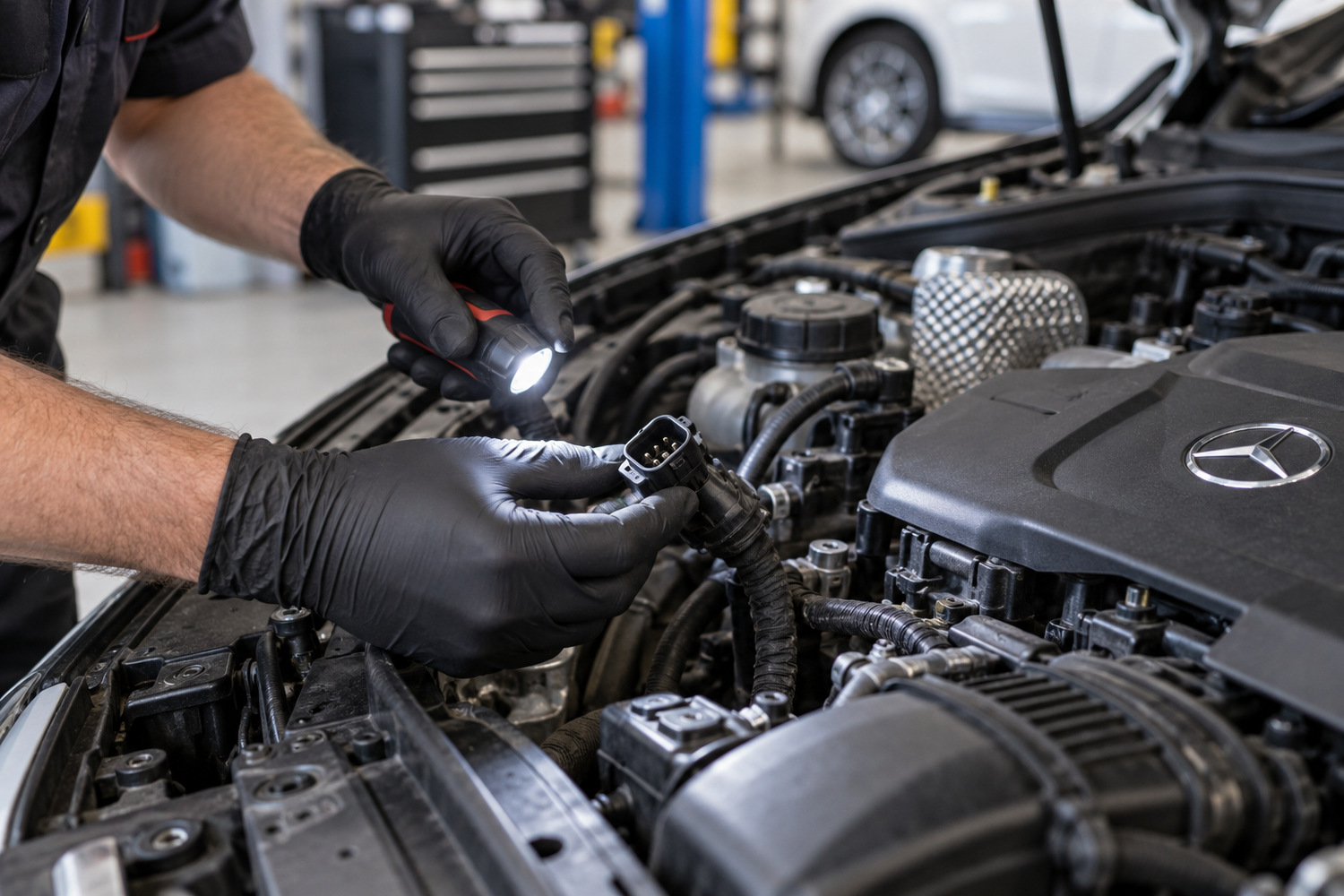
A fault code is a short record the car stores when a reading falls outside what the computer expects. It names a circuit or a component. It does not name a cause.
A scan reads those records out, which is where the work starts rather than where it ends. A car turns up most weeks with a code naming a sensor. The fault turns out to be the plug or the wiring running to it. Replacing the sensor on the strength of the code buys a new part and leaves the car as it was.
The same gap sits between a scan and a price. A scan is not a quote. The code sets the direction, and the cost depends on what the testing finds. A price put on the job before that is a guess.
How do you describe a Mercedes fault so it gets found?

The useful detail is when the fault happens, not what you think is behind it.
Say whether the car is cold or warmed up. Say roughly what speed, and whether you are accelerating, holding steady, or coasting. Say whether it happens every time or now and then. Say what changed, and when.
A fault that only shows in the first ten minutes is a different search from one there all day. Saying so narrows the search before anyone picks up a tool. If a message comes up on the dash, read it out word for word rather than describing it. The exact wording points at the system that raised it.
Frequently asked questions
Can an independent workshop service a Mercedes under warranty?
Yes, provided the work follows the manufacturer’s schedule and specifications, the right parts go in, and the records are kept. The condition is the standard of the work, not who did it. There is a fuller account on this site of what a Mercedes service after warranty should check.
Does a Mercedes warning light mean you should stop driving?
Not by itself. Ask whether the warning is about something that stops the car or something that reports on it. A brake or park brake message sits in the first group, and that one is a stop. An emissions message sits in the second, and gives you distance.
How often does a Mercedes need servicing?
Mercedes sets the timing by both time and distance, and many cars work it out as they go and raise a service reminder. Follow what your car shows. Mercedes servicing once the warranty has ended has its own page here, and the dashboard letter is explained there.
Is an older Mercedes worth keeping?
That turns on which repairs are in front of you rather than on the badge. The faults set out here are seals, sensors, and actuators. They are replaceable parts on a sound car. The test is what the next year of work is worth against the car.
Book a Mercedes diagnostic
Karl Knudsen Automotive does Mercedes service and repair in Chatswood, including the diagnostic work the faults above need.
If you are booking off the back of a warning, bring the wording of the message and a note of when it appears. That turns the first part of the job from a search into a test.
Book a diagnostic online, and put what the car is doing in the booking note.

