
A new set of tyres can feel like the obvious answer when the tread is worn. The problem is that uneven tyre wear is often a symptom, not the cause.
If a tyre has worn badly on one edge, developed patchy low spots, or started making the steering wheel shake, replacing the tyre may only reset the clock. The next set can wear the same way unless the alignment, wheel balance, suspension, steering, or tyre pressure issue is found first.
The quick answer: uneven tyre wear often points to toe or camber issues, worn suspension bushes, tired shocks, poor wheel balance, incorrect tyre pressure, or impact damage from a pothole or kerb strike. NSW also requires tyres to be in good condition, with at least 1.5mm of tread and no excessive uneven wear.
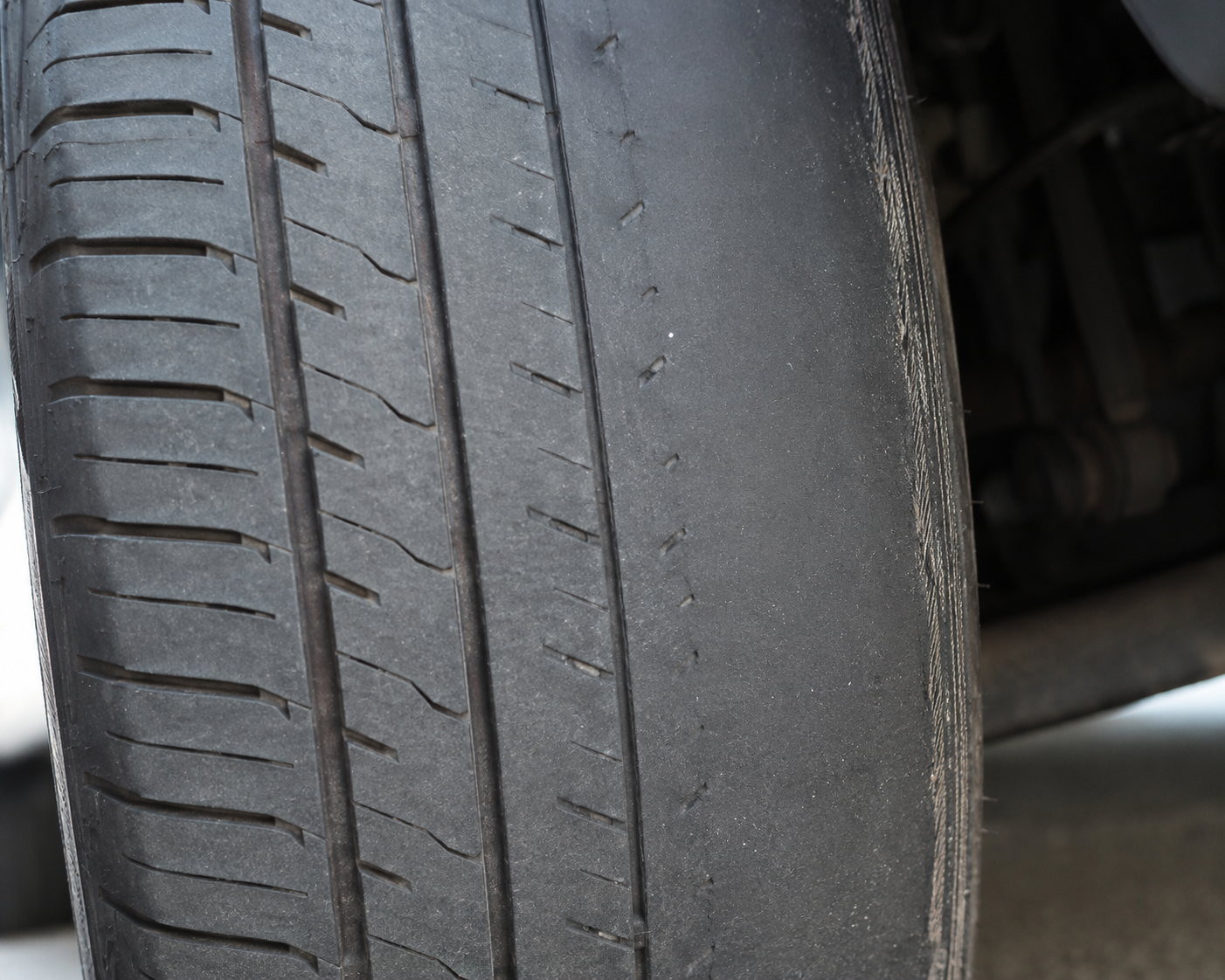
What does uneven tyre wear usually mean?
Uneven tyre wear means the tread is not wearing evenly across the tyre or around its circumference. It is different from normal wear, where the tread gradually gets lower across the whole tyre.
The pattern matters. A tyre worn smooth across the full width may simply be old or near the end of its life. A tyre worn heavily on the inside edge, outside edge, centre, or in patches is giving you more information.
Common causes include:
- incorrect wheel alignment
- underinflated or overinflated tyres
- poor wheel balance
- worn shock absorbers or struts
- worn control arm bushes, ball joints, or steering parts
- a bent rim
- a recent hit to a pothole, kerb, or parking ramp edge
This is why a tyre inspection should not stop at the tyre. The wear pattern can point to what the car is doing underneath.
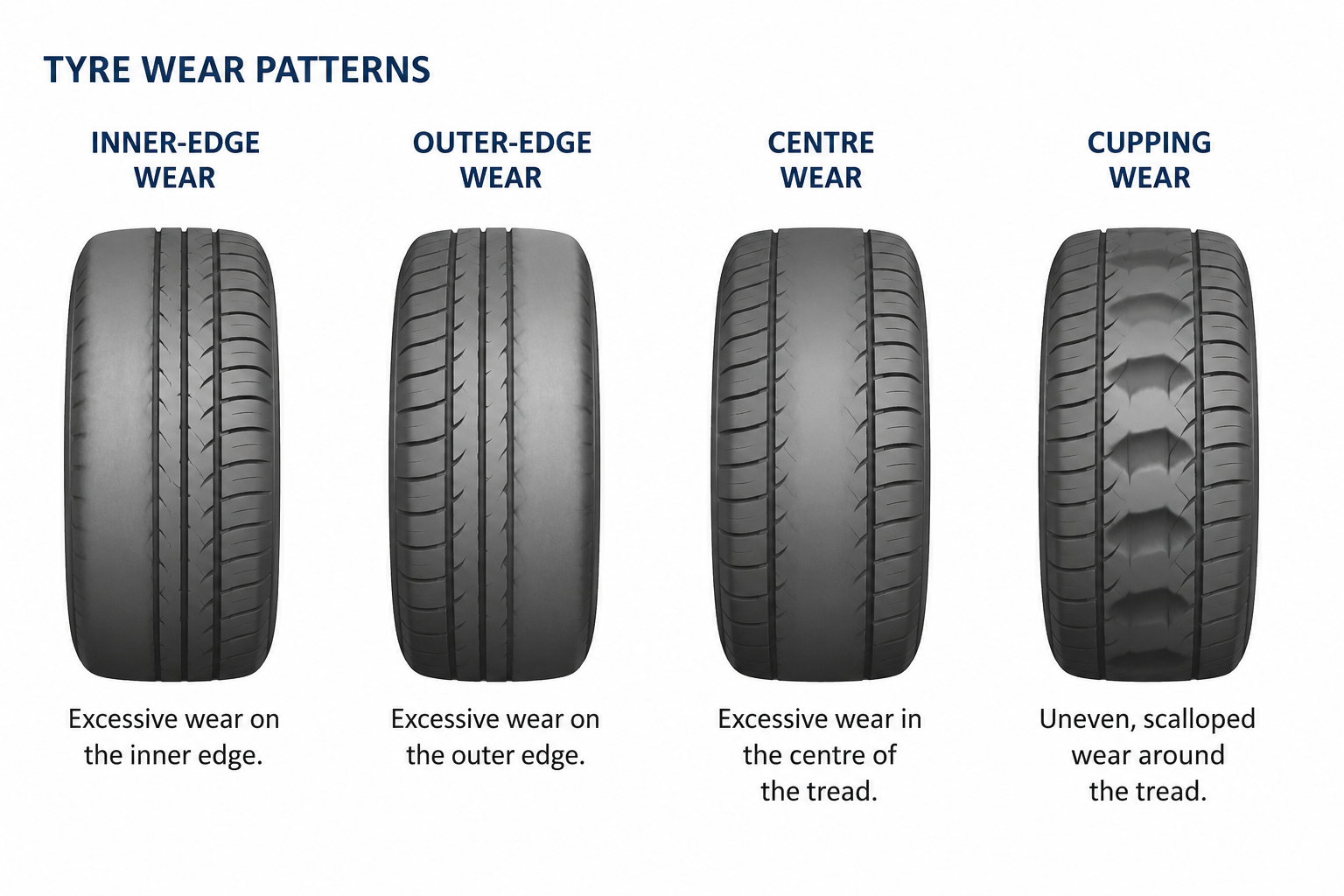
How do tyre wear patterns point to the cause?
No tyre wear pattern proves one fault on its own. A mechanic still needs to inspect the car. But the pattern gives a useful starting point.
| Wear pattern | What it looks like | Likely cause | What to check next |
|---|---|---|---|
| Inner-edge wear | Inside shoulder wears faster than the rest of the tyre | Toe or camber issue, worn suspension bushes, lowered or altered geometry | Wheel alignment, control arms, bushes, ball joints |
| Outer-edge wear | Outside shoulder wears faster | Alignment issue, low tyre pressure, cornering load, worn front-end parts | Tyre pressure, alignment, suspension movement |
| Both shoulders worn | Both outer edges look rounded or low | Underinflation or heavy load use | Tyre pressure, load setting, tyre condition |
| Centre wear | Middle of the tread wears faster | Overinflation or incorrect pressure for load | Tyre pressure against the door placard |
| Cupping or scalloping | Patchy dips around the tyre | Worn shocks, poor wheel balance, suspension movement | Shock absorbers, struts, wheel balance |
| Feathering | Tread blocks feel sharp one way and smooth the other | Toe alignment issue | Toe setting, steering components |
Michelin's Australian tyre guidance links both-edge wear with underinflation, centre wear with overinflation, and one-edge or patchy wear with alignment, camber, bushes, or dampers.
Why can European cars be sensitive to alignment?
Many European cars use low-profile tyres, firm suspension, and precise steering geometry. That can make them feel stable and accurate when everything is right. It can also make tyre wear show up quickly when something is slightly out.
A BMW, Mercedes, Audi, Volkswagen, MINI, or similar European car may not need a dramatic fault to start wearing a tyre unevenly. A small alignment change after a pothole hit, a worn control arm bush, or an out-of-balance wheel can be enough.
The cost issue is practical. European tyres are often expensive, especially where the car has larger wheels, staggered tyre sizes, or performance tyres. Replacing a worn tyre without fixing the cause can mean paying for the same problem twice.
When does steering wheel vibration point beyond the tyre?
Steering wheel vibration is often blamed on tyres, and sometimes that is correct. A wheel balance problem can cause vibration, especially at higher speeds. RAC WA notes that steering wheel vibration at higher speeds is a common sign that a wheel balance may be needed.
But vibration can also come from:
- uneven tyre wear
- a bent rim
- worn suspension bushes
- worn ball joints
- steering rack or tie rod wear
- brake rotor issues, especially if the vibration appears under braking
Karl Knudsen's existing steering wheel vibration article also links vibration to tyre balance, uneven tyre wear, suspension components, and brake rotor issues.
The timing of the vibration helps narrow it down.
| When the vibration happens | More likely cause |
|---|---|
| At higher road speeds | Wheel balance, tyre wear, bent rim |
| Under braking | Brake rotor or brake system issue |
| While turning | Steering or suspension movement |
| After hitting a pothole or kerb | Alignment change, rim damage, suspension damage |
| At low speed with noise | Tyre damage, wheel bearing, suspension or brake issue |
If the vibration is new, getting worse, or paired with uneven tyre wear, the tyre should not be treated as the only suspect.
What should be checked before another tyre set?
Before fitting another tyre set, the car should be checked as a system. That is especially important if the tyres have worn unevenly, the steering wheel is vibrating, or the vehicle pulls to one side.
A proper check should usually include:
- tread depth across each tyre
- tyre age, cracks, bulges, and sidewall damage
- tyre pressure against the vehicle placard
- wheel balance
- wheel alignment, including toe and camber
- bent rims or impact damage
- control arm bushes
- ball joints and tie rods
- shock absorbers and struts
- wheel bearings where symptoms suggest it
- a short road test where safe
Karl Knudsen's tyre and wheel page lists tyre pressure checks, wheel balancing, rotation, tread wear inspections, wheel alignment where required, tyre repairs where viable, and TPMS diagnostics as part of its tyre and wheel service offering.
Can a wheel alignment fix uneven tyre wear?
A wheel alignment can fix the cause if the problem is only incorrect alignment.
It will not fix a worn-out tyre. It also will not hold properly if worn suspension or steering parts are allowing the wheel to move under load. In that case, the car can be aligned on the machine but still shift out of position when it is driven, braked, or turned.
That is why the order matters:
- Inspect the tyres and wear pattern.
- Check steering and suspension for movement or worn parts.
- Repair any worn components that affect wheel position.
- Align the vehicle.
- Balance wheels if vibration or new tyres make it necessary.
- Recheck tyre wear at a later service.
RAC WA notes that kerb strikes, potholes, uneven surfaces, normal wear, and steering or suspension work can all affect alignment. It also explains that alignment relates to angles such as camber, toe, and caster.
When is replacement still the right call?
Sometimes the tyre still needs replacing. Diagnosis does not avoid that.
Replacement is usually the right call when:
- tread is at or near the legal minimum
- the tyre has worn unevenly past a safe point
- cords are visible
- there are bulges, deep cuts, or sidewall damage
- the tyre is old, cracked, or perished
- the tyre has been damaged by driving while underinflated
- the wear pattern has made the tyre noisy or unsafe
NSW Government guidance says tyres must be in good condition, must not be smooth, must have at least 1.5mm tread, must be inflated to the recommended pressure, and must not have cracks, bumps, or uneven wear.
The point is not to avoid buying tyres. It is to avoid fitting another set before the real cause is understood.
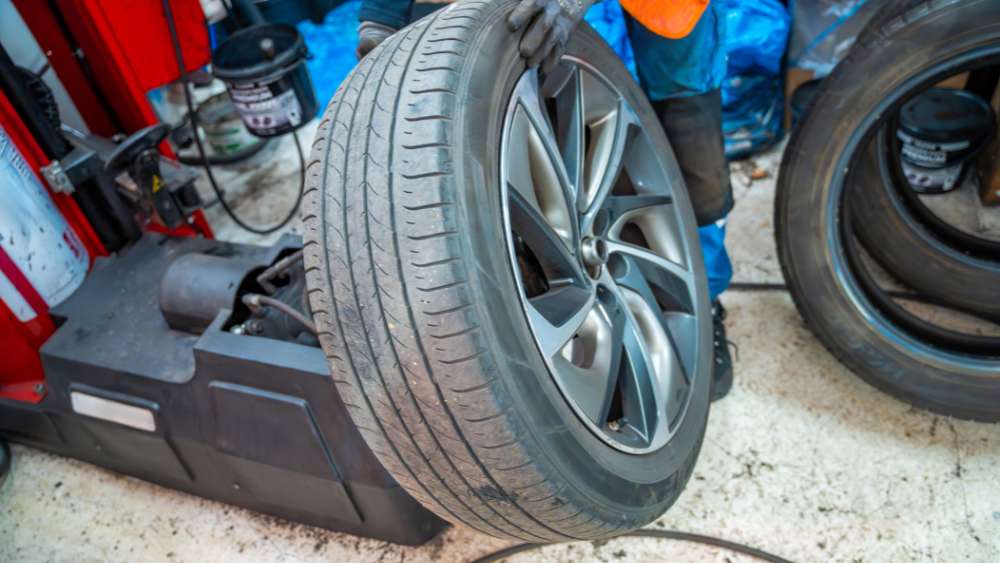
What should you tell the mechanic?
A clear description helps the inspection start in the right place.
Before booking, note:
- which tyre looks worn
- whether the wear is on the inside, outside, centre, or in patches
- whether the steering wheel vibrates
- the speed where vibration starts
- whether the car pulls left or right
- whether the vibration happens under braking
- whether the car recently hit a pothole, kerb, or parking ramp edge
- when the tyres were last rotated, balanced, or aligned
For a North Shore driver dealing with Chatswood traffic, tight parking, and daily commuting, those small details can matter. A light kerb strike during parking may be enough to start a wear pattern that only becomes obvious months later.
Before you replace the tyres, check the cause
Uneven tyre wear is not just a tyre problem. It is a clue about how the car is sitting, steering, braking, and contacting the road.
If the tyre is worn out, it may need replacing. But if the underlying cause is alignment, suspension movement, wheel balance, pressure, or impact damage, the next tyre set is at risk too.
For European vehicles, a tyre, steering, and suspension check before replacement can save money and give a clearer answer. Karl Knudsen Automotive in Chatswood can inspect the tyre wear pattern, check the steering and suspension, and confirm whether the fix is a tyre, an alignment, a balance, a suspension repair, or a combination.
frequently asked question
Inside-edge tyre wear often points to camber or toe alignment issues. It can also be caused by worn suspension bushes, ball joints, or other steering and suspension parts.
It can contribute, but wheel balance, tyre damage, bent rims, worn suspension parts, and brake issues can also cause vibration. The speed and situation where the vibration appears matter.
If the old tyres show uneven wear, have the steering and suspension checked before fitting new tyres. If no worn parts are found, an alignment is usually sensible when the new tyres are fitted.
It can be. NSW Government guidance says tyres must be in good condition and must not be worn unevenly. Tyres also need at least 1.5mm of tread.

