
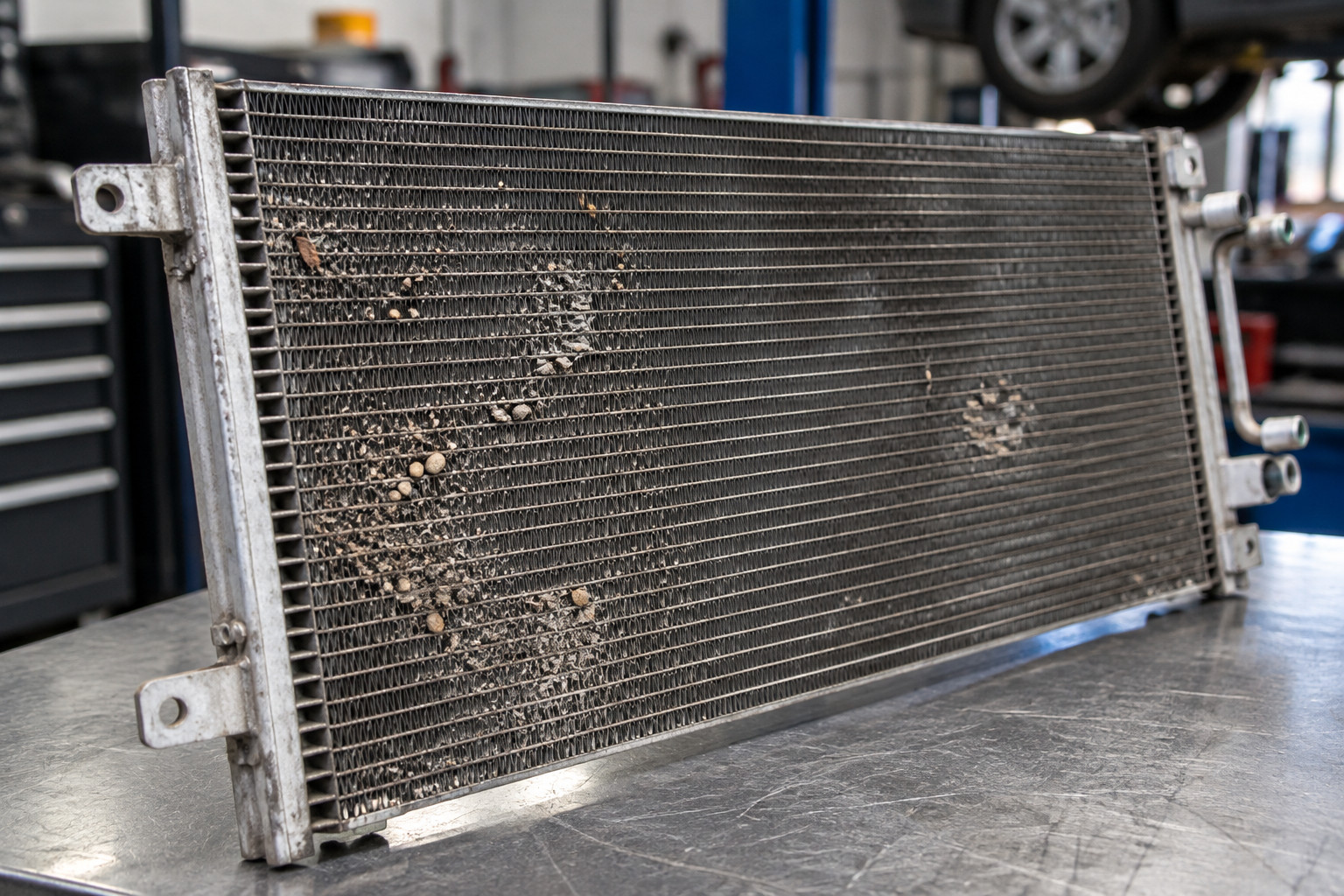
Car aircon repair starts with working out which part has failed. That is settled by a pressure test and a leak test, not by how the air feels. Four parts fail often enough to matter: the condenser, the compressor, the evaporator, and the cheaper things that are not really the aircon at all. Each one is confirmed a different way, and confirming it comes before any part is ordered.
The first three handle refrigerant, the gas that carries heat out of the cabin.
| The part | What it does in the system | How it is confirmed |
|---|---|---|
| Condenser | Sheds the heat the refrigerant has picked up, at the very front of the car | Dye or a pressure test, often with a stone chip visible at the leak |
| Compressor | Pumps the refrigerant round the system, driven by a belt on most cars | Pressure readings either side of the pump, plus a scan tool reading |
| Evaporator | Takes heat out of the air blown into the cabin, from behind the dashboard | Dye or a detector at the drain tube, once everything else is cleared |
| Cabin filter or condenser fan | Move air over or through the system, so cooling fails while the aircon is fine | A look at the filter, and a listen for the fan with the aircon on |
Why a regas is the first test, not the repair
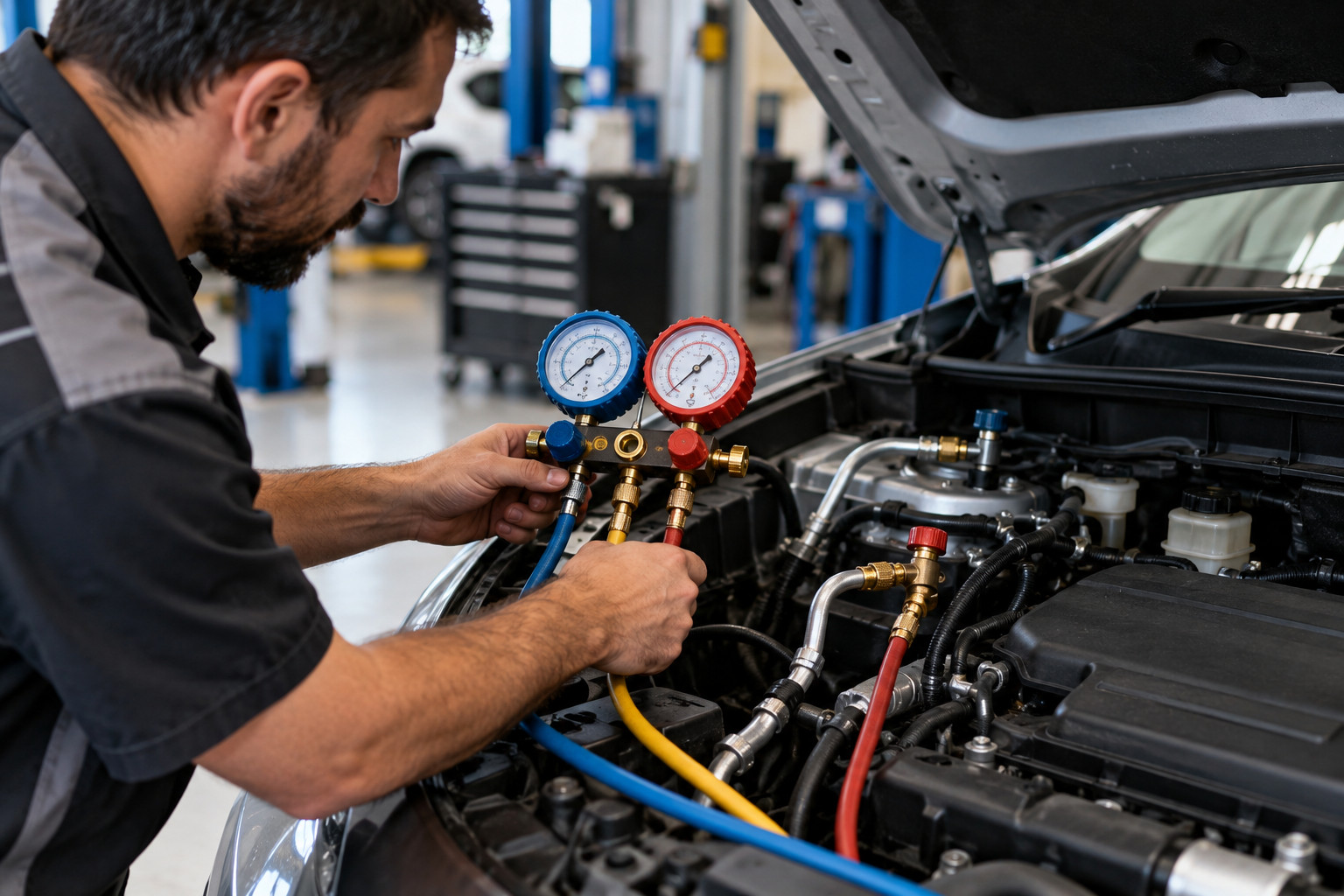
A regas refills the system with refrigerant. Refrigerant is not used up the way fuel is. The system is sealed, so a car that is low has lost gas somewhere.
That makes a regas useful twice over. If the cold holds through summer, the charge was simply low and that was the job. If it fades in a few weeks, the regas has told you the system leaks. There is a separate guide to what a regas costs and what it includes.
Air con leak repair: how a car’s leak is found
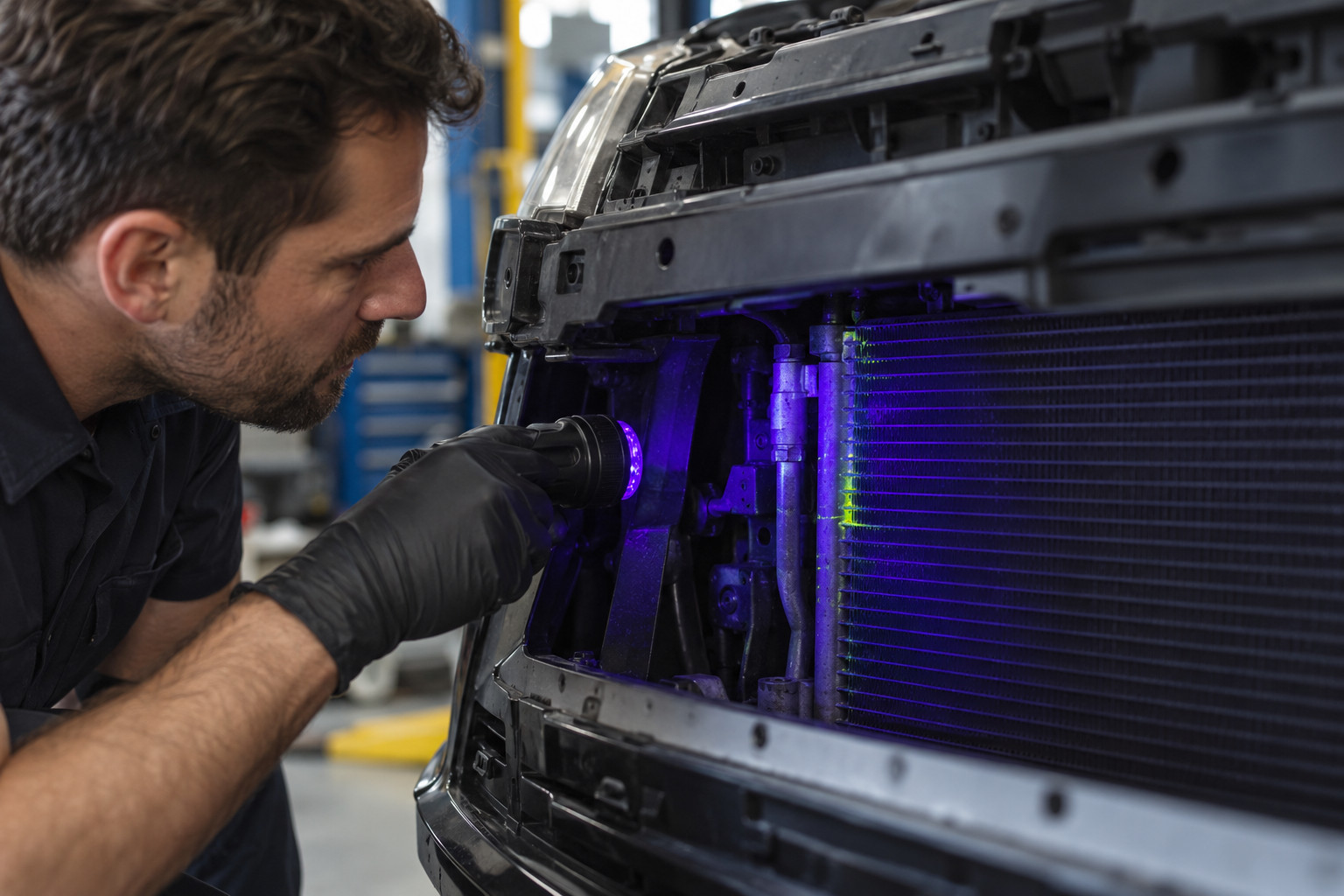
Air con leak repair on a car begins with finding the leak. A workshop has three ways to do it, and each shows something the others miss.
A system that needs topping up once a year is still leaking. A sealed circuit should never need gas at all.
- UV dye and a black light. Dye goes in with the refrigerant and the car is driven for a few days. Under an ultraviolet lamp it glows bright green at the spot the gas escaped from. It is the most precise method, but it needs those days first.
- A nitrogen pressure test. Dry nitrogen is pumped in above normal working pressure and the gauge is watched. This shows whether the system holds, and how fast it falls. That separates a slow weep from a hole, though it does not point at the spot.
- An electronic leak detector. A hand held probe that reacts to refrigerant in the air. It finds very small leaks quickly in still air. A breeze or a solvent nearby can set it off, so it points rather than proves.
The condenser is the part most likely to be leaking
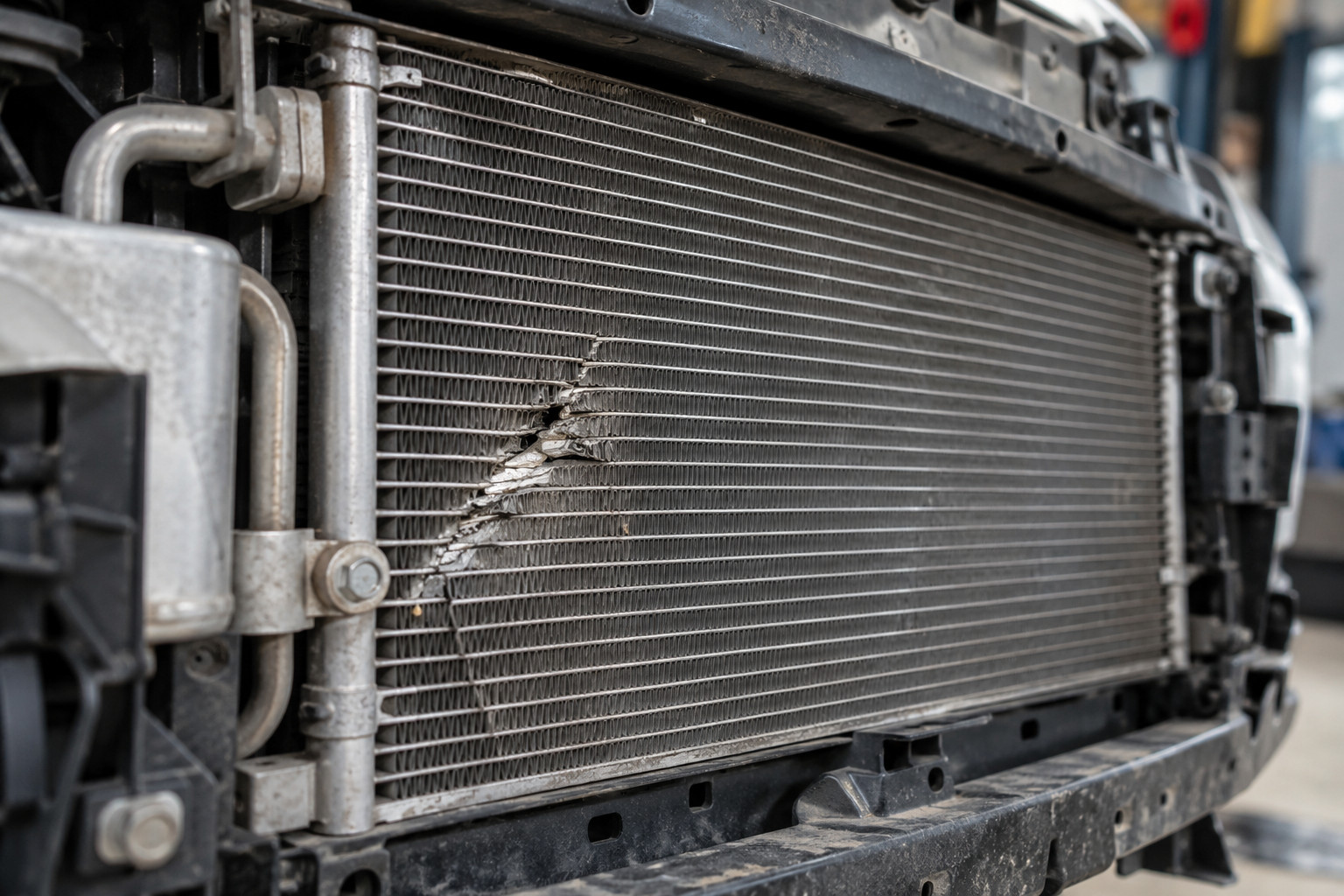
The condenser is a thin aluminium panel at the very front of the car, behind the grille. Hot gas arrives from the compressor, air passing through the fins carries the heat away, and the gas turns back into liquid.
Its position is the problem. Everything the front of the car meets, the condenser meets first: stones off the Pacific Highway, grit, road spray and salty air near the water. The tubes inside have thin walls, because thin metal sheds heat fastest.
A condenser out of the car tells the story plainly. The fins are packed with grit and insects, there is usually a dimple where a stone landed, and the dye trail runs from one pinhole no wider than a pen tip.
Car air conditioning condenser repair is rarely a repair. Patching aluminium that thin means heat, and heat near the damage opens the next weak spot along. A new one comes pressure tested from the factory. A patched one cannot be.
When it is the compressor
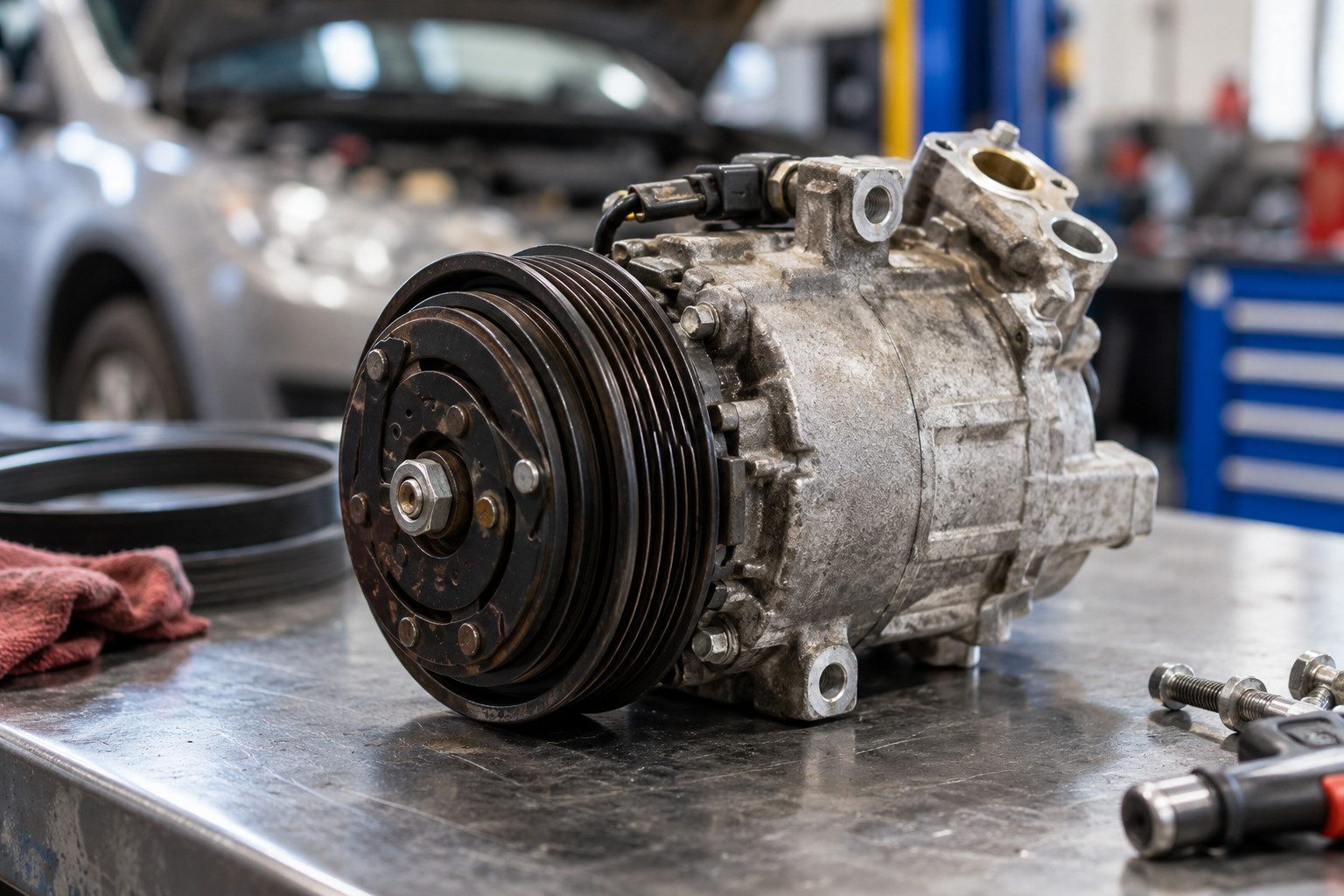
The compressor is the pump. On most cars it is bolted to the engine and driven by a belt, and it pushes the refrigerant round under pressure.
Three things point at it. The first is noise, usually a rattle or grind that starts the moment the aircon goes on. The second is the clutch, a plate on the front of the pulley that clicks in when cooling is called for. If it never clicks in, the fault is often electrical or a low charge rather than the pump. The third is a scan tool. It compares what the car asked the compressor to do with what the pressures show it did.
Internal failure changes the size of the job, not just the price of the part. When a compressor breaks up inside, fine metal travels into the pipes with the oil, and a new pump fitted onto that debris dies the same way. So the lines are flushed, pushing solvent through until they run clean. The receiver-drier, a canister that keeps moisture out, is replaced as a matter of course. So is the expansion valve that meters gas into the evaporator. That is why a compressor job is bigger than a compressor.
The oil that lubricates the pump travels round with the refrigerant, so a system with no gas has no oil moving either.
When it is the evaporator
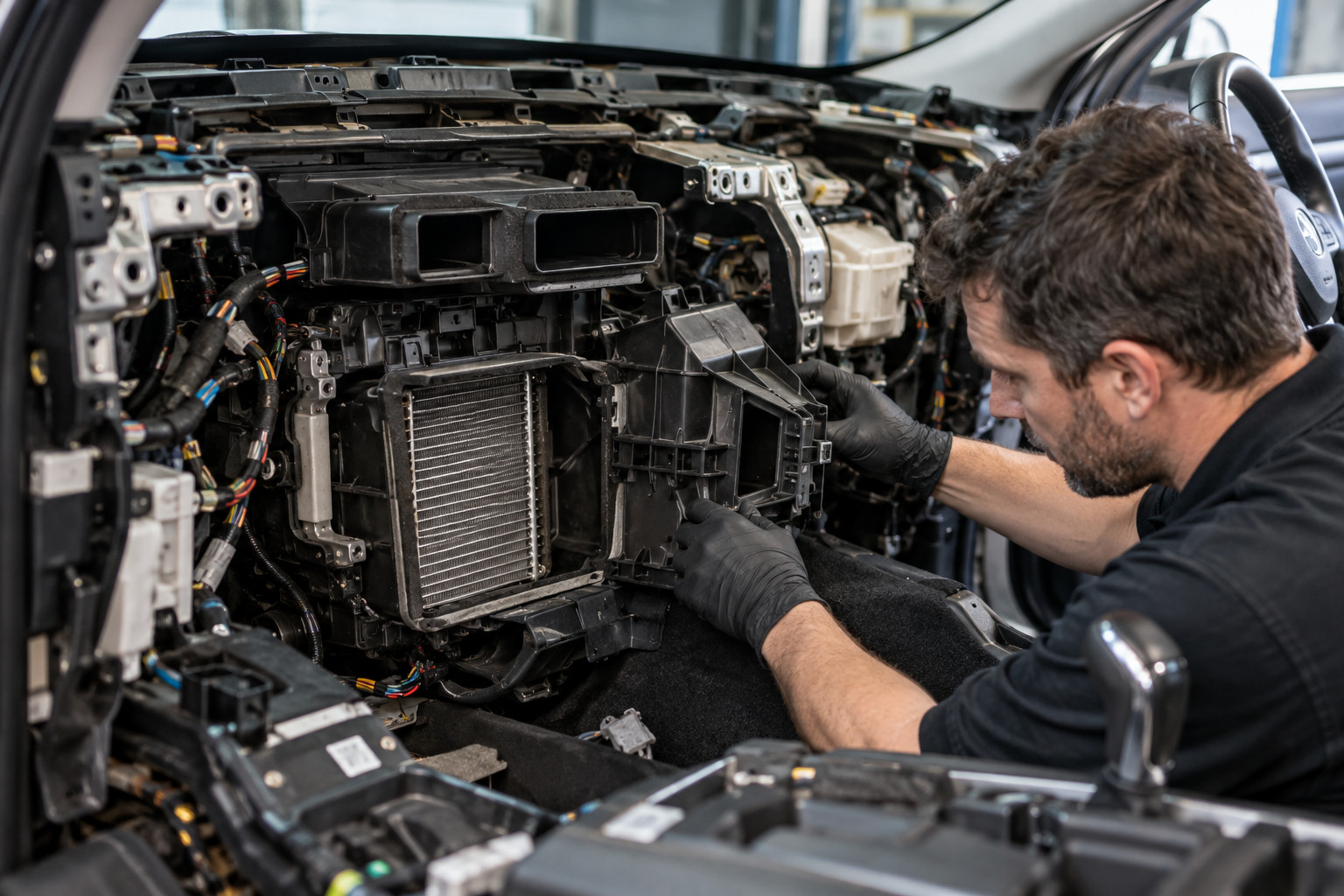
The evaporator is the cold part, behind the dashboard. Warm cabin air blows across it, the refrigerant inside takes the heat out, and the water that condenses drains out through a tube under the car.
Being out of sight makes it awkward to confirm. The usual approach is to clear everything else, then look for dye at the drain tube or hold a detector in a vent. A smell of refrigerant in the cabin points the same way.
Reaching it means taking the dashboard out, and that labour is most of the bill. It is the one failure worth confirming twice, because the work is the same whether the diagnosis was right or wrong.
When it is not the aircon at all
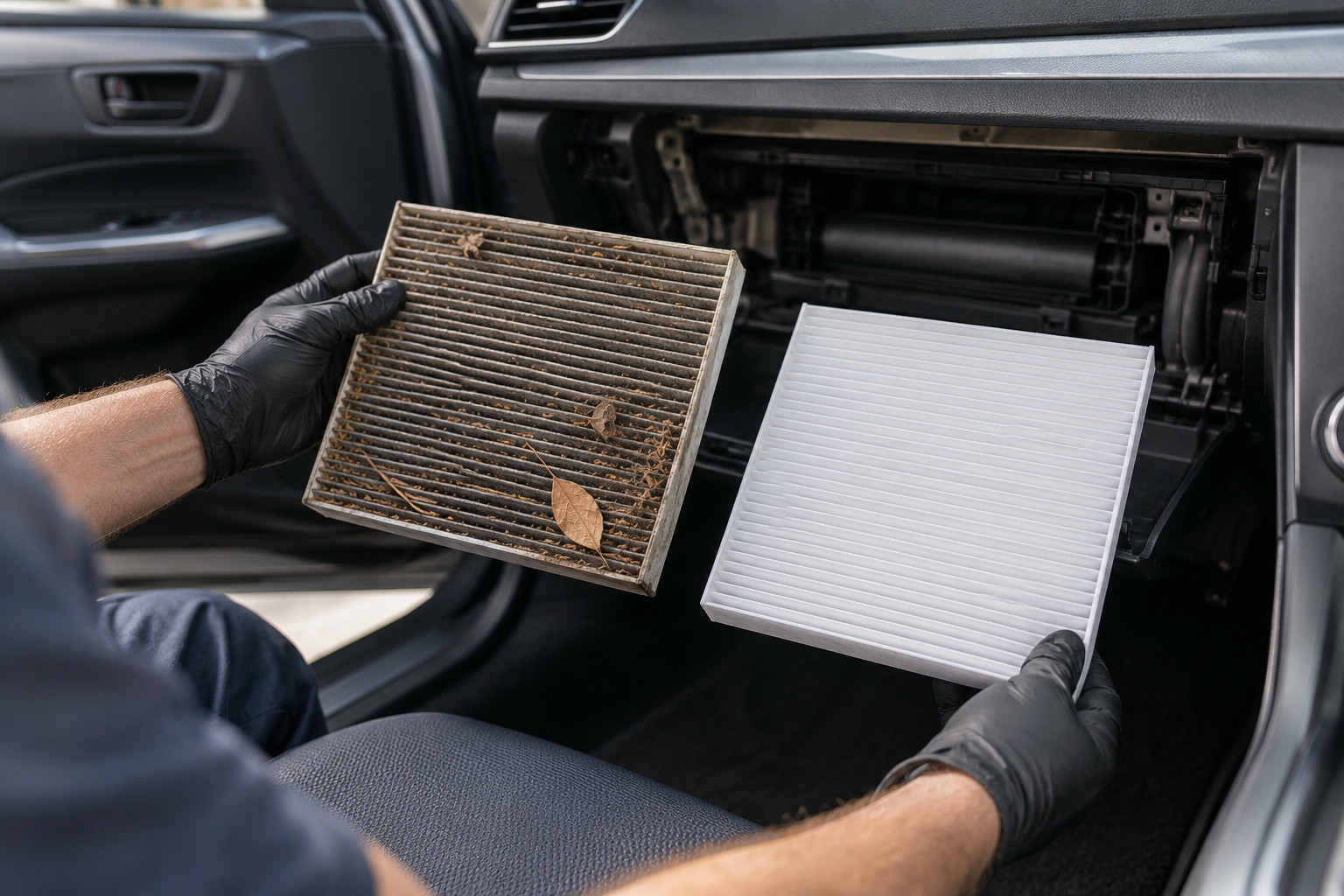
Some cars arrive for aircon repairs when the aircon is fine. Three checks rule these out in minutes.
If the air is warm rather than weak, a separate guide to why your car aircon is blowing warm air works through the symptoms in order.
- A blocked cabin filter. The cabin filter cleans the air on its way into the car. When it clogs, airflow at the vents drops right off while the air is still cold. On most cars it pulls out for a look.
- A condenser fan that has stopped. The fan pulls air through the condenser when the car is not moving. Without it, cooling is fine on the motorway and fades at the lights.
- A fuse or a wiring fault. The compressor never gets the signal to engage, so nothing happens at all. It looks like a major failure and is one of the cheapest to put right.
What a European system changes about the job
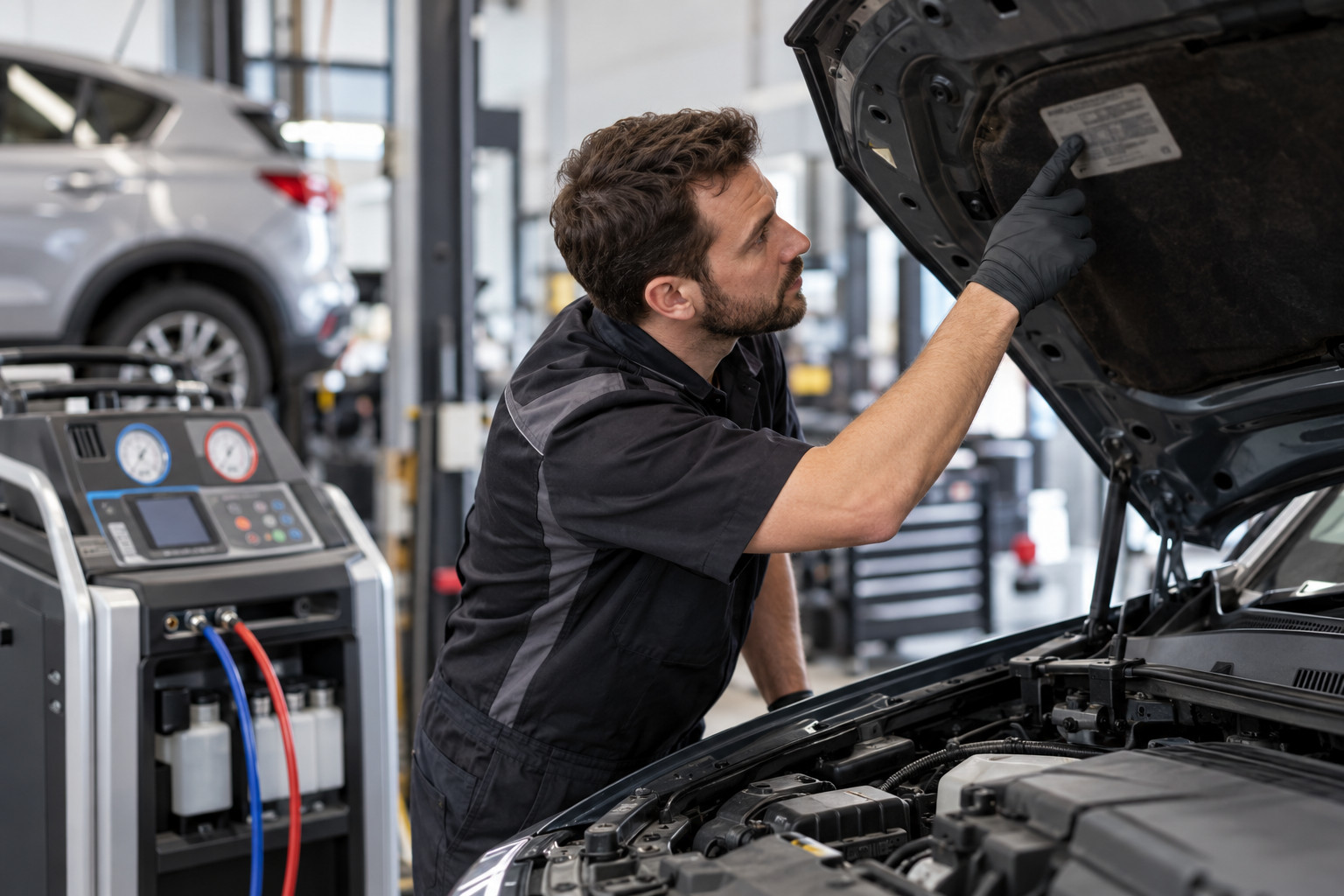
- The refrigerant changed. Older cars run R134a. From 1 January 2017, new cars could no longer be sold in the European Union with an aircon refrigerant above a set greenhouse rating. That rule is Directive 2006/40/EC, and most makers moved to R1234yf. The two are not interchangeable. The service fittings differ on purpose, and the gear for one does not work on the other.
- Some models drive the compressor electrically. On hybrid and electric cars the compressor has its own motor instead of a belt, so it keeps cooling with the engine off. That brings a different oil. Standard PAG oil does not insulate well enough to sit against motor windings, so these compressors use POE oil, and mixing the two is not a small mistake.
- Parts can take longer to arrive. A condenser for a common small car sits on a shelf in Sydney. One for a less common European model may come from overseas, so ask where the part is coming from when you ask what it costs.
Is car aircon repair worth it on an older car?

Sometimes the honest answer is no, and it turns on which part failed rather than the car’s age.
A leaking condenser on a ten year old car is usually worth doing. It is an outside part, it comes out from the front, and the rest of the system is untouched. A compressor that has failed internally is the opposite case. It brings the flush, the drier, the valve and a full recharge with it. On a car near the end of its life that is hard to justify. An evaporator is harder still, because most of the money goes on reaching the part.
Nothing forces the decision. Air conditioning is not an item in the Transport for NSW Light Vehicle Safety Check Standards, which a pink slip is inspected against, so a car with no cooling still passes. The one related check is the windscreen demister, which passes as long as air blows onto the glass.
There is one argument against leaving it. The seals stay soft because oil moves round with the gas, so a car left empty for two summers needs more work later.
Karl Knudsen Automotive handles aircon repairs on European cars, and a pressure test turns a guess into a diagnosis. If the cooling faded last summer and nobody has looked since, book an aircon inspection online before the first hot week rather than during it.
Frequently asked questions
Can you keep topping up a leaking system and just drive it?
It works for a while, then stops working sooner each time. The real cost is the pump, which is lubricated by oil carried round with the gas, so a system run low wears out early. Finding the leak once beats paying for the same gas every summer.
Does running the aircon in winter help?
Yes. Ten minutes of use every few weeks keeps oil moving through the pump and past its seals. Seals that stay soft are slower to start the next leak.
How long does an aircon repair take?
It depends more on which part failed than on which car it is. A condenser comes out from the front and is the shortest of the four. A compressor that broke up inside adds the flushing and the parts with it. An evaporator means taking the dashboard out, and a part nobody stocks locally adds more waiting.
Will a faulty aircon fail a pink slip?
No. The NSW safety check standards do not list air conditioning among the items an inspector tests, so lost cooling is not a reason to fail. The only related item is the windscreen demister, which passes so long as air blows onto the glass.

